Executive Summary: automatic bollards provide secure, flexible access control solutions for government buildings, supporting both crash-rated hostile-vehicle mitigation and traffic management needs. Selecting the correct bollard requires matching threat profiles, foundation capabilities, and integration needs—ensuring both perimeter security and a cohesive streetscape.
Introduction: Securing the perimeter of government buildings is a high-stakes challenge—balancing the need to prevent unauthorized vehicle entry while allowing seamless access for authorized personnel and deliveries. Traditional fixed barriers or staffed entry points can disrupt both operations and the aesthetic harmony of civic environments. Automatic bollards offer a discreet, adaptable solution, rising on demand to block or allow vehicle entry at critical access points. This article examines the precise applications, technical considerations, and decision frameworks surrounding automatic bollards for government building access control—grounded in rigorously validated product knowledge and global industry standards.
Featured Snippet: Government building access control using automatic bollards delivers adaptable perimeter protection—providing crash-rated vehicle mitigation or traffic management as required—while preserving the appearance and pedestrian flow of civic and embassy environments. Effective deployment requires correct threat assessment, foundation planning, and standards-compliant system integration.
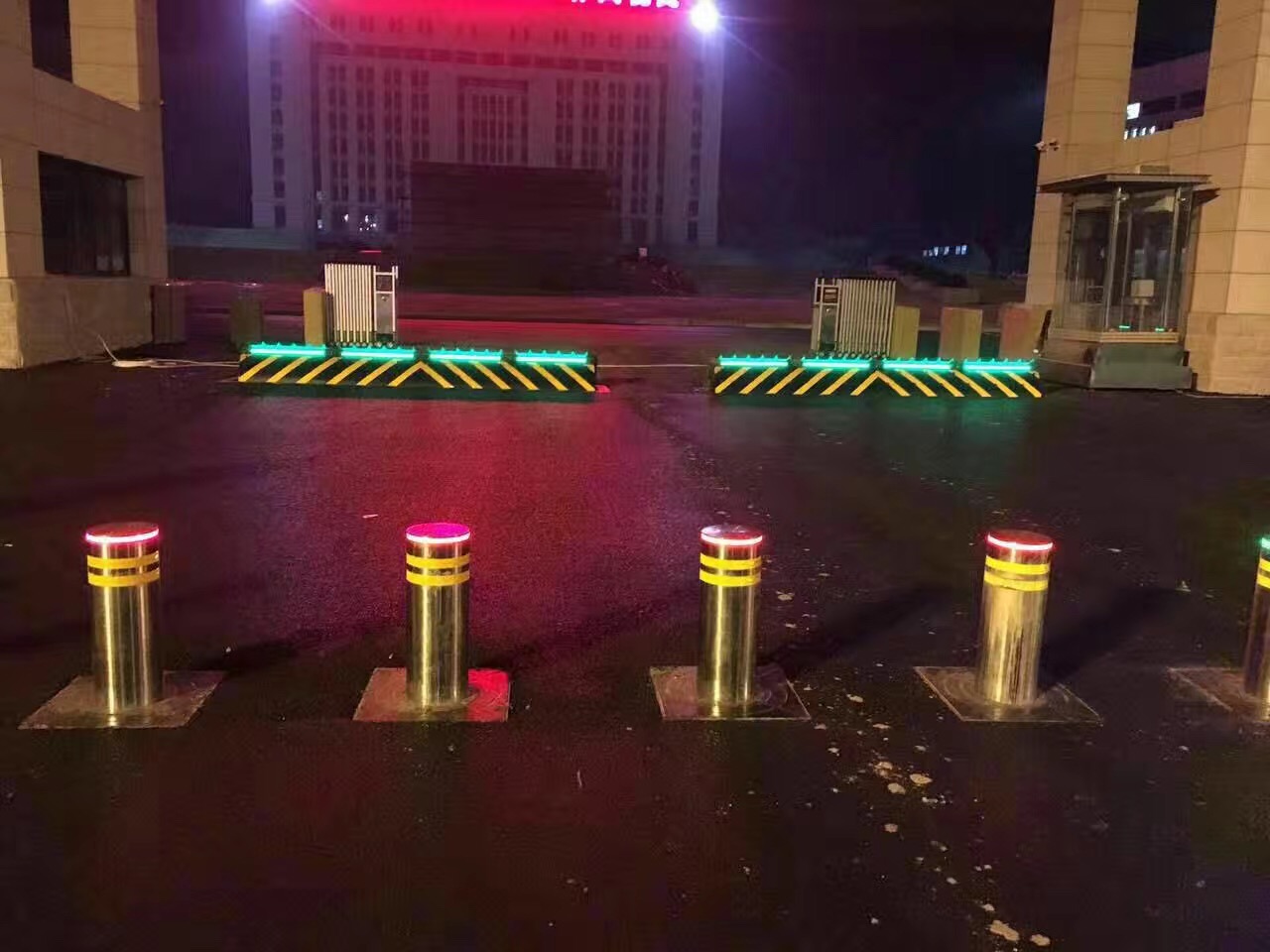
Automatic bollards are rising and retractable barriers installed flush with road surfaces, controlling vehicle passage without permanent visual or physical obstructions. Their deployment enables security teams to restrict, grant, or regulate vehicle access to sensitive government perimeters or internal campus roads—often without dedicated on-site personnel. Unlike traditional gates or static bollards, automatic variants allow seamless retraction, maintaining emergency access and aesthetic continuity in pedestrianized government plazas, embassies, or city center zones.
Two main categories exist: crash-rated bollards—engineered and independently tested to halt hostile vehicles under standards such as ASTM F2656/F2656M or IWA 14-1—and non-rated traffic-management bollards, designed to deter or regulate routine access but not stop vehicle attacks. Selection depends on a candid threat assessment and operational risk profile.
Automatic bollards rise and descend via hydraulic or electromechanical drives. Hydraulic systems—long the industry standard for high-duty, crash-rated models—employ pressurized fluid to move thick-steel cylinders vertically. Electromechanical actuators, now increasingly common for lower-threat and lower-maintenance traffic-management applications, use industrial-grade motors and lead screws or belts for precise vertical motion. Crash-rated models always feature robust, reinforced internal geometry and steel construction for withstanding kinetic impact.
Foundation requirements are driven by both threat level and civil site constraints. Foundation geometry is model- and test-configuration-specific. Use the manufacturer’s installation drawing and a site-specific civil design; changing the tested foundation configuration can invalidate the stated impact rating. Correct drainage within the foundation pit is critical: water ingress can cause operational fouling or freeze mechanical units in colder climates.
All government installations must plan for power loss events. Fail-safe logic defines whether bollards default to the raised (secure) or lowered (open) position on outage—mandatory documentation for operational safety. Options include backup battery/UPS integration or manual override release for first responders. Duty cycle is model-specific. State the required cycles per day and verify that requirement against the selected bollard and control-unit data sheets.
For hostile-vehicle mitigation, specifiers should only consider bollards with independently verified test results aligned with recognized frameworks such as ASTM F2656/F2656M (U.S.) or IWA 14-1 (international). True crash-rated systems will have a documented, named test performed by an accredited body—there is no legitimate substitute for this. Government projects may require submittals, drawings, and commissioning checks to align with security master plans, local accessibility/streetscape ordinances, and emergency access provisions.
Non-rated traffic-control bollards must still meet local codes for accessibility, reflectivity, and non-slip surface finishes, especially in mixed vehicle/pedestrian-use areas. Integration with existing building access-control or credentialing systems ensures seamless, auditable operation as part of a wider security ecosystem.
Facilities managers and property operators should progress through the following selection criteria when planning a government building access-control upgrade:
Base this on a formal risk assessment. If your site faces credible threats of vehicle-borne attack or hosts sensitive/diplomatic activities, only a bollard with a verified crash-test rating (e.g., ASTM F2656 or IWA 14-1) provides assured hostile-vehicle-mitigation. Sites limiting parking, coordinating deliveries, or demarcating pedestrianized spaces but not facing high-speed threats can specify non-rated traffic-management bollards, benefiting from lower cost and faster installation.
Foundation geometry is model- and test-configuration-specific. Use the manufacturer’s installation drawing and a site-specific civil design; changing the tested foundation configuration can invalidate the stated impact rating.
This is dictated by system fail-safe configuration: some models default to the raised (blocked) position, others retract to allow free passage. For critical government access points, integration of battery/UPS backup or dedicated manual release ensures bollards can be raised/lowered during outages. Always specify the desired behavior in your procurement documents and test response procedures on site.
Modern bollard control panels accept triggers from a range of inputs: proximity card readers, remote-control fobs, central security consoles, or ANPR platforms. Confirm the selected controller’s supported interface—commonly dry-contact I/O or a site-specific access-control gateway—and document the integration and fail-safe logic before procurement.
While service regimes mirror commercial models, government sites may impose more frequent checks or stricter documentation. Border, embassy, or high-security locations should include visual, mechanical, and electronic functionality tests in site security drill protocols, with escalation paths for detected failures.
Automatic bollards, specified and installed to appropriate standards, provide a robust and flexible vehicle access-control solution for government sites worldwide. Their ability to provide crash-rated protection or unobtrusive, credentialed street management—while preserving civic aesthetics—makes them especially valued in government, embassy, and urban public-realm applications. Evaluate genuine threat levels, site engineering realities, and integration/deployment needs at the outset; for best outcomes, describe your specific requirements to a technical security provider well-versed in crash ratings and access-control integration.
Planning a government-site bollard project? Send the threat level, design vehicle mass and approach speed, lane width, expected daily cycles, available foundation depth, and required power-loss behavior. Request a model-specific bollard recommendation and quotation.